Thrown After
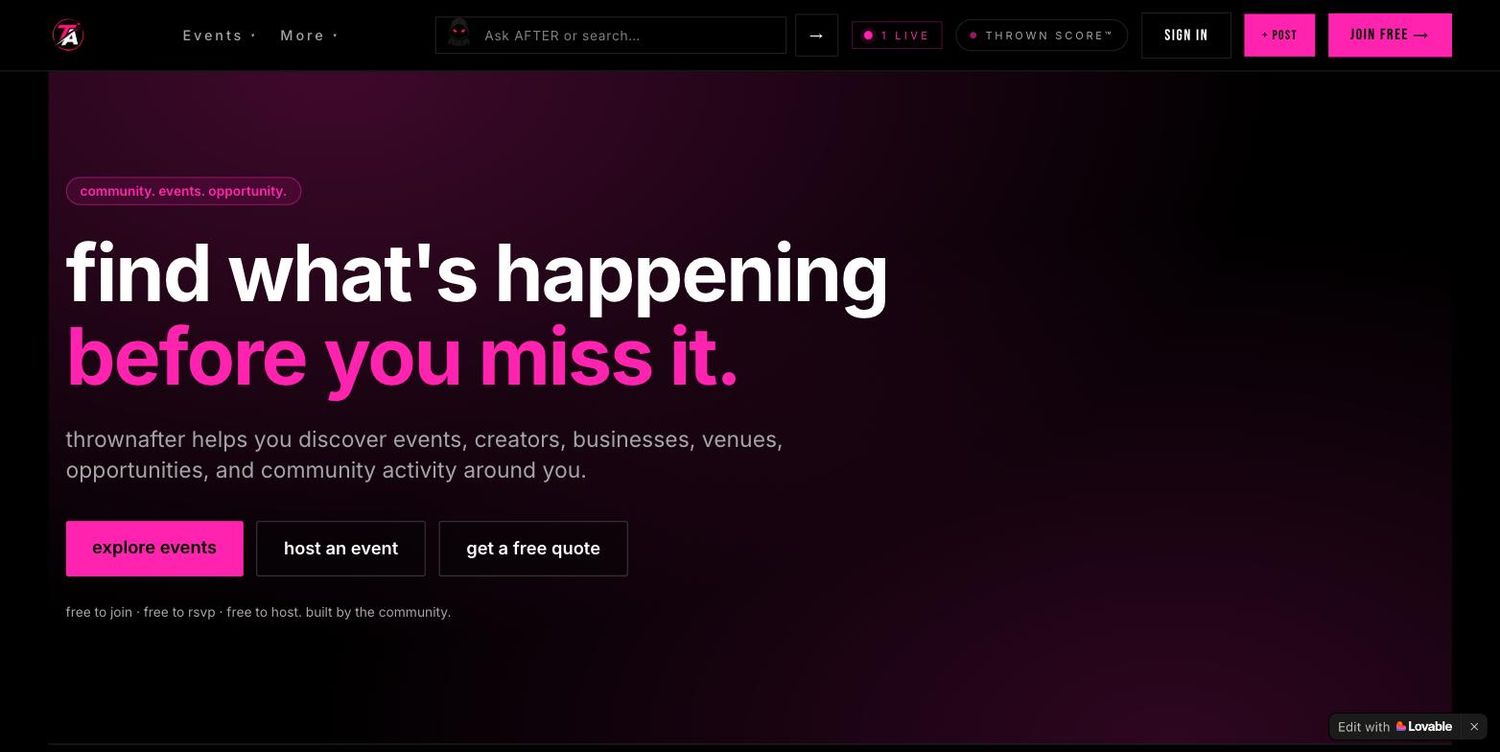
Community. Events. Opportunity. Thrown After is a local discovery platform — one place for events, creators, venues, businesses, nonprofits, and jobs. I designed and built it end to end, launched it, then made the call to shelve and rebuild it properly. Code intact; a native iOS app is in development.
The idea
Local scenes are scattered across a dozen apps — one for events, another for creators, a jobs board, a nonprofit page, a business directory — and none of them talk. If you want to find what is happening around you, you check five places and still miss things.
Thrown After was the attempt to put all of it in one place: “Community. Events. Opportunity.” Events, creators, venues, businesses, nonprofits, and jobs in a single discovery layer, with claimable listings and an AI assistant to route you to what matters.
What I built
Discovery platform
One feed spanning events, creators, venues, businesses, nonprofits, jobs, and funding — a single place to find what is happening locally.
Claimable listings
Businesses, venues, and organizations could claim and run their own listing, so the directory could grow itself.
AFTER™ assistant
A built-in AI assistant to help people find and post the right things instead of getting lost in a raw feed.
Founders Club + referrals
An early-member Founders Club and a referral/ambassador system to seed the first community and reward the people who grew it.
Full app UI
End-to-end designed screens — a “post anything” router, onboarding, profiles, a follower system, groups, search, and subscriptions.
Brand identity
A self-designed “THROWN AFTER” wordmark plus a “TA” secondary mark and monogram — the identity across the whole product.
Deliverables & build
◉ Proof: a real platform, designed and built end to end, launched, then deliberately shelved on 2026-06-29 with the code kept intact. It is being rebuilt from scratch with a native iOS app in development. This is honest status — a shelved flagship, not a running product. No user or traction numbers are claimed.
Why it matters
Shelving your own flagship is the honest move most portfolios hide. The scope was real and the build was real, but the right call was to stop, keep the code, and rebuild it properly rather than prop up something that was not ready. The identity and the product thinking carry forward into the rebuild.